
What is a SID and STAR in aviation?
A SID (Standard Instrument Departure) is a published flight route from a runway to the en-route airway structure. A STAR (Standard Terminal Arrival Route) is the opposite - a published route from the en-route structure down to an airport.
Both define a sequence of waypoints with altitude and speed restrictions at each fix. Pilots follow these automatically when cleared by ATC.
Why they exist
Without published procedures, every aircraft would need individual routing instructions from the controller. SIDs and STARs let controllers say "descend via the PARCH4 arrival" instead of issuing a dozen separate altitude, heading, and speed commands. They keep traffic flowing predictably through busy airspace.
How they work
A STAR typically looks like this:
- Aircraft enters the procedure at a transition fix (where en-route traffic joins)
- Follows the common route through a series of waypoints, descending to meet altitude constraints at each
- Branches onto a runway transition for the specific landing runway
Each waypoint can have constraints:
- At - must cross at exactly this altitude (200ft tolerance)
- At or above - minimum altitude gate
- At or below - maximum altitude ceiling
- Between - must be within an altitude window
Speed restrictions work the same way. Below 10,000ft, all aircraft must stay at or below 250 knots.
Example STAR: RAVNN8 arrival into Baltimore (KBWI)
Here's what a real STAR looks like. The RAVNN8 arrival brings traffic into Baltimore-Washington International from the south.
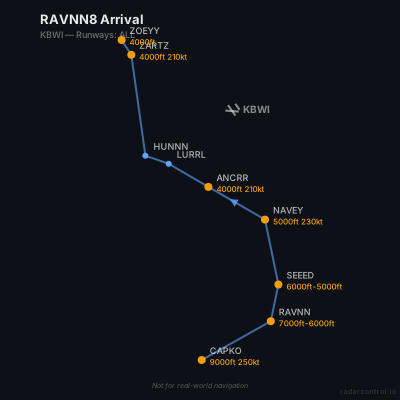
The route starts at CAPKO and works its way north toward the airport through 9 waypoints. Each constraint tells the pilot what altitude and speed to be at when crossing that fix:
| Fix | Altitude | Speed | What it means |
|---|---|---|---|
| CAPKO | At 9,000ft | 250kt | Entry fix - must be exactly at 9,000ft, slowed to 250kt |
| RAVNN | Between 6,000-7,000ft | - | Altitude window - pilot has 1,000ft of flexibility |
| SEEED | Between 5,000-6,000ft | - | Continuing descent through another window |
| NAVEY | At 5,000ft | 230kt | Exact altitude, slower speed for approach sequencing |
| ANCRR | At 4,000ft | 210kt | Final approach altitude, approach speed |
The profile view shows this as a staircase descent from 9,000ft down to the airport:
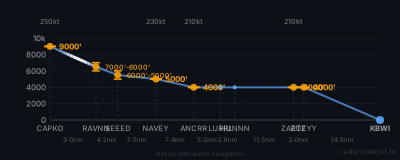
Notice how the constraints get tighter as the aircraft gets closer to the airport - wider windows at the start, exact altitudes near the end. This is typical. The controller can override any constraint with a crossing restriction if traffic requires it.
View full RAVNN8 details | All KBWI procedures | Play Washington Center
Example SID: GTLKE5 departure from Cleveland (KCLE)
SIDs work in reverse - they define the climb-out path from the runway to the en-route structure.
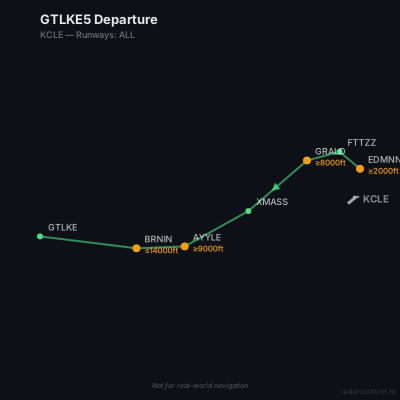
The GTLKE5 departure takes aircraft northeast from Cleveland toward the Great Lakes:
| Fix | Altitude | What it means |
|---|---|---|
| EDMNN | At or above 2,000ft | Must be climbing through 2,000ft by this fix |
| GRALD | At or above 8,000ft | Climb gate - minimum altitude to clear terrain/traffic |
| AYYLE | At or above 9,000ft | Another climb gate |
| BRNIN | At or below 14,000ft | Ceiling - don't climb above this until cleared by center |
The profile shows the aircraft climbing from the airport through each gate:
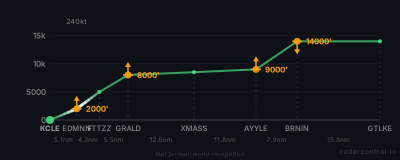
SID constraints typically use "at or above" (minimum altitude gates) to ensure terrain clearance, with an occasional "at or below" ceiling to keep departures under arriving traffic.
View full GTLKE5 details | All KCLE procedures | Play Cleveland Center
SIDs and STARs in radarcontrol.io
Here's what these procedures look like on the radar display. The dashed route line connects waypoints with altitude and speed constraints shown at each fix.
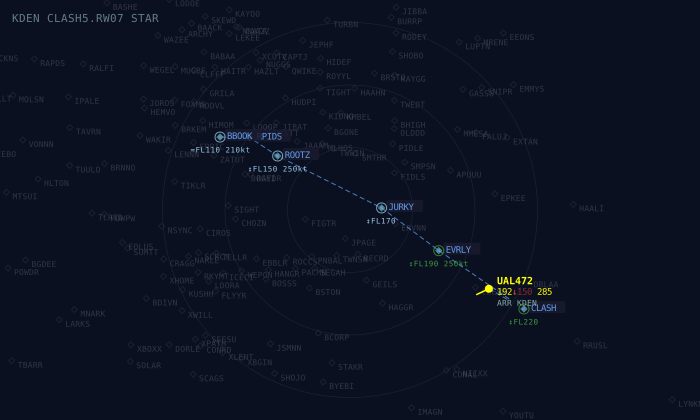
An arrival following the CLASH5 STAR into Denver. Blue dashed line shows the remaining route. Constraint rings mark altitude/speed restrictions at each fix - green means satisfied, light blue means pending.
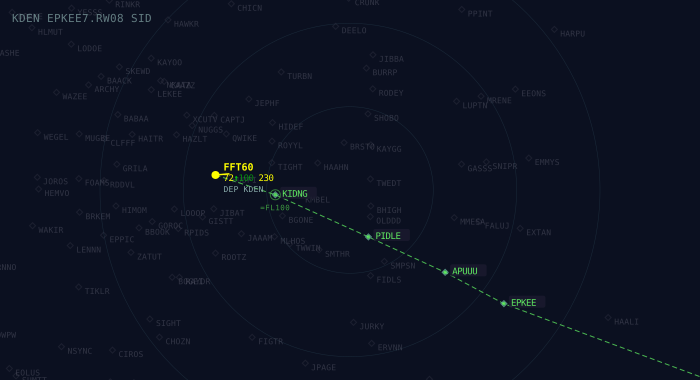
A departure following the EPKEE7 SID from Denver runway 08. Green dashed line shows the SID route eastbound through KIDNG, PIDLE, to the EPKEE transition.
radarcontrol.io includes real SID/STAR procedures sourced from FAA CIFP data for US airports. You can:
- Issue
dv(descend via) to have an aircraft follow STAR constraints automatically - Issue
cv(climb via) for SID departures - Override individual constraints with
x GREKI 240(cross GREKI at FL240) - Cancel restrictions with
xp - Write JavaScript scripts that react to constraint events