
How arrivals are sequenced
Every arrival at a busy airport needs to end up on final approach, in a single line, properly spaced, at the right speed. Getting them there is the core challenge of approach control. It's called sequencing.
At a major airport, 30-60 aircraft per hour arrive from all directions, at different speeds and altitudes. The controller's job is to merge them into an orderly stream with exactly the right gap between each one.
The arrival funnel
Think of it as a funnel. Aircraft enter from many directions at the wide end. They all need to come out the narrow end, one by one, lined up on the ILS.
The process works in stages:
- Aircraft arrive at the boundary of the approach airspace on published STARs
- Controllers descend them and assign speeds to start building the sequence
- Aircraft are vectored toward a common merge point or final approach course
- Spacing is refined with speed adjustments and small heading changes
- Each aircraft gets cleared for the approach in order
The whole thing has to flow continuously. You can't stop the funnel to sort things out.
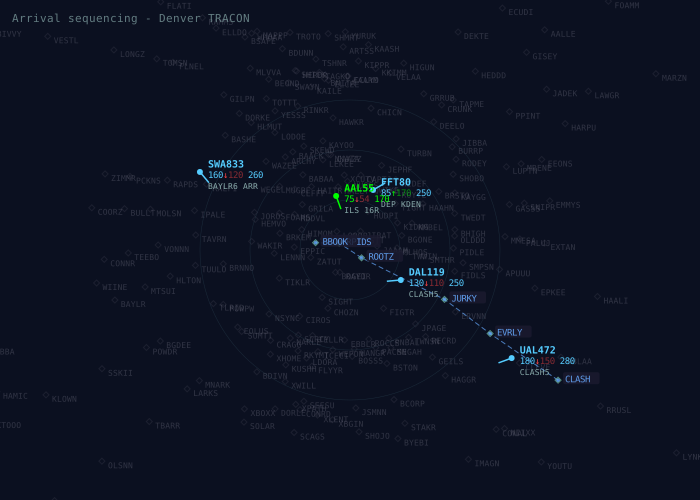
The arrival funnel at Denver TRACON. Two CLASH5 arrivals from the east at different stages of descent, an arrival from the northwest, a departure climbing out to the northeast, and AAL55 already established on the ILS 16R. The controller must merge all these streams into a single sequence.
Miles in trail
The basic spacing tool is "miles in trail" (MIT). This is one of several flow control measures that ATC uses to manage traffic demand. MIT means maintaining a set distance between successive aircraft on the same route. Common values:
- 5 MIT - normal spacing for radar environments
- 10 MIT - used for wake turbulence or flow control
- 15-20 MIT - heavy delay programs, weather, or reduced runway capacity
A center controller might get a restriction from the TRACON: "10 miles in trail to KATL." That means every aircraft headed for Atlanta must be at least 10 miles behind the one in front when they reach the handoff point.
MIT keeps the TRACON from getting overloaded. If aircraft arrive too bunched up, the approach controller can't sequence them fast enough and the whole system backs up.
Speed control
Speed control is the most precise sequencing tool. Small speed differences create predictable gaps. Note that the speeds controllers assign are indicated airspeed, not ground speed - so wind affects the actual spacing rate.
A typical sequence: the lead aircraft is doing 210 knots. The trailing aircraft is at 250 knots and closing. The controller slows the trailing aircraft to 210 as well, and the gap stabilizes. If the gap is still too small, slow the trailer to 190 for a bit, then bring them back to 210 once the spacing is right.
Below 10,000 feet, the 250-knot speed limit helps. Everyone's in a similar speed range, making spacing more manageable.
On final approach, speed control is very fine-grained. The difference between 170 and 160 knots over a 10-mile final creates about 30 seconds of additional spacing. That's often exactly what you need.
Vectoring
When speed alone isn't enough, controllers use heading vectors to physically move aircraft off their route and reposition them.
Common vectoring techniques:
Base turn - swing an aircraft out wide and then turn them back in to intercept final at a greater distance. This adds miles and therefore time.
S-turns - snake an aircraft left then right to eat up distance without going far off course. Useful when you just need a little more spacing.
Extended downwind - send an aircraft parallel to the runway in the opposite direction before turning them onto base and final. A longer downwind means more distance to the runway.
360-degree turn - a full circle eats about 3-4 minutes. A last resort for big spacing problems.
The goal is always to get the aircraft back onto final approach at the right point, at the right altitude, with enough space behind the aircraft in front.
Merge points
Many STARs are designed to bring traffic from different directions to a common merge point. A well-designed STAR funnels traffic onto one fix, where the controller then sequences them onto final.
For example, the CHPPR1 arrival into Atlanta brings traffic from the northwest through a series of waypoints with altitude and speed constraints. Other STARs bring traffic from the northeast, south, and west. They all converge in the approach airspace where the controller merges them.
The altitude and speed constraints on the STAR do a lot of the sequencing work automatically. "Descend via" (dv) lets the aircraft follow the published profile without individual altitude instructions.
Wake turbulence spacing
Wake turbulence adds another spacing requirement on final approach. Heavy aircraft create wing tip vortices that can roll a smaller aircraft behind them.
Required spacing on final:
- Heavy behind heavy: 4nm
- Large behind heavy: 5nm
- Small behind heavy: 6nm
- Heavy behind super (A380): 6nm
These minimums override the standard 3nm radar separation. A sequence of mixed aircraft types means the controller has to adjust the gap for each pair.
In radarcontrol.io
Sequencing is where the sim gets challenging. You use a combination of dv (descend via STAR), speed commands (s210), heading vectors (h270), and direct-to commands (d FIXNAME) to build your arrival sequence.
If an arrival reaches the end of its route without an ILS clearance, it will hold at the last waypoint until you clear it for an approach. Plan your sequence so aircraft get their ILS clearance before running out of route.
The scoring system rewards good sequencing:
- +80 for each successful landing
- +30 for establishing aircraft on the ILS
- -50 for go-arounds (usually caused by bad spacing)
- +75 for efficient descents with no level-offs
Practice sequencing at these busy airports:
- Atlanta (KATL) - Six STARs including CHPPR1 and HOBTT3. Five runways to manage. Play now.
- Charlotte (KCLT) - Multiple STARs like BANKR5 converging on parallel runways. Play now.
- JFK (KJFK) - Use the PARCH4 STAR and vector onto the ILS. Play now.
Guides: Arrivals & ILS approaches | Scoring system
Related: What is a SID and STAR? | What are ATC clearances? | What is wake turbulence?
Play N90 TRACON - build arrival sequences into JFK, LaGuardia, and Newark.