
What is a conflict alert?
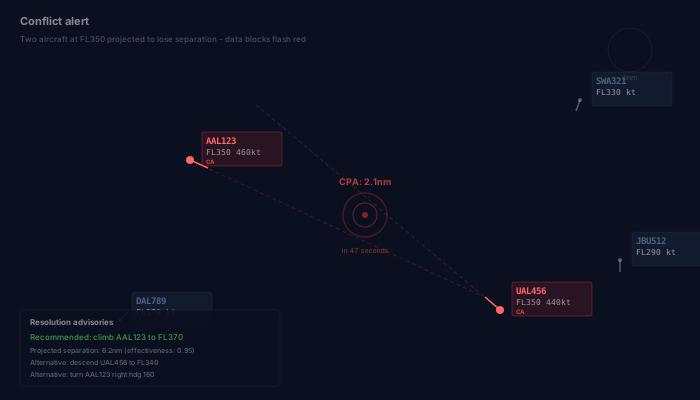
A conflict alert (CA) is an automated warning that fires when the ATC system predicts two aircraft are about to lose separation. The affected aircraft data blocks flash red on the radar display, and an audible alarm sounds in the controller's headset.
It means: fix this now, or these two aircraft are going to get too close.
How the system works
The conflict alert system constantly projects each aircraft's trajectory forward in time. It looks at current position, altitude, speed, heading, and climb/descent rate, then calculates where every aircraft will be in the next 2 minutes.
If the projection shows two aircraft will violate separation minimums (less than 3nm laterally in terminal, 5nm in center, or less than 1,000ft vertically), the alert triggers.
The system runs continuously. Every radar update, every few seconds, it recalculates. An alert can appear suddenly if an aircraft turns or changes altitude unexpectedly.
What the controller sees
When a CA fires, two things happen at once:
The data blocks of both involved aircraft start flashing or turn red. The data block is the little tag next to each radar target showing callsign, altitude, speed, and other info. When it's flashing red, it grabs your attention immediately, even in dense traffic.
An aural alert sounds. In some facilities it's a tone. In others it's a distinctive chime. Either way, it's hard to miss.
The controller also sees projected closest approach information. How close will these aircraft get, and when. That tells you how urgent the situation is and how much time you have to act.
How controllers respond
Speed matters. When a CA fires, you don't deliberate.
Immediate options:
- Turn one or both aircraft away from each other
- Climb one and descend the other
- Issue a speed change to increase spacing
- If they're already vertically separated, confirm altitudes are correct and monitor
The choice depends on the geometry. If aircraft are at the same altitude converging head-on, a turn is fastest. If they're at different altitudes but one is climbing through the other's level, stopping the climb is the fix.
Sometimes the CA is a false alarm. An aircraft was descending to a level that would conflict, but you already issued a stop altitude. The system doesn't always account for pending clearances. Experienced controllers learn to read the situation quickly and distinguish real threats from nuisance alerts.
But you never ignore a CA. Even if you think it's a false alarm, you verify.
Types of conflict severity
Not all conflicts are equal. ATC systems classify them:
- Caution - aircraft are trending toward a conflict but aren't close yet. Time to plan.
- Warning - separation will be lost within the prediction window. Act soon.
- Critical - separation is already lost or about to be lost within seconds. Act immediately.
A caution gives you options. A critical alert means you're already in trouble and need to issue an instruction right now.
In radarcontrol.io
radarcontrol.io simulates conflict detection with WASM-accelerated projection looking 5 minutes ahead. Conflicts show as red indicators on the radar with the projected closest approach.
The system classifies conflicts by severity:
- Critical: less than 3nm lateral separation
- Warning: less than 4nm
- Caution: projected to lose separation
Scoring penalties are steep: -200 points per conflict, -150 extra for severe conflicts (lateral < 2nm or vertical < 500ft). A single crash costs -500. Good separation management is the difference between positive and negative scores.
Practice recognizing and resolving conflicts:
- New York Center (ZNY) - Crossing traffic creates frequent conflict situations. Play now.
- Atlanta Center (ZTL) - Heavy arrival flows into ATL bunch up quickly. Play now.
- New York TRACON (N90) - 3nm separation with six airports. No margin for error.
Related: How does ATC separation work? | What is TCAS? | What is radar separation?
Play Fort Worth Center - practice conflict detection and resolution in your browser.