
What are NAT tracks?
North Atlantic Tracks (NATs) are a set of organized routes across the Atlantic Ocean, published twice daily. They're the busiest oceanic airspace in the world - roughly 1,500 aircraft cross the North Atlantic every day, mostly between North America and Europe.
Why organized tracks exist
The North Atlantic has no radar coverage. Controllers can't see aircraft on a screen the way they do over land. Without radar, separation standards are much larger - 60nm lateral, 10 minutes longitudinal. If everyone picked their own random route, fitting 1,500 aircraft through with those separations would be impossible.
NAT tracks solve this by funneling traffic onto a handful of parallel routes, spaced apart, at specific flight levels. Think of them as temporary highways across the ocean.
How tracks are built
Every day, Shanwick (UK) and Gander (Canada) oceanic control centers publish new track coordinates. The routes change daily because they're optimized for the jet stream.
Westbound tracks (Europe to North America) are published in the morning UTC, active roughly 01:00-08:00 UTC. They're routed to take advantage of tailwinds or avoid headwinds.
Eastbound tracks (North America to Europe) are published in the afternoon UTC, active roughly 11:00-19:00 UTC. These are usually further north to ride the jet stream eastbound.
Each track is identified by a letter. Westbound tracks start from the beginning of the alphabet (A, B, C...), eastbound from the end (Z, Y, X...). A busy day might have 6-8 tracks in each direction.
Example NAT tracks
Here's what a typical set of westbound tracks looks like across the Atlantic. Each line is one track, spaced roughly 1 degree of latitude apart. The tracks curve northward mid-ocean to account for jet stream positioning.
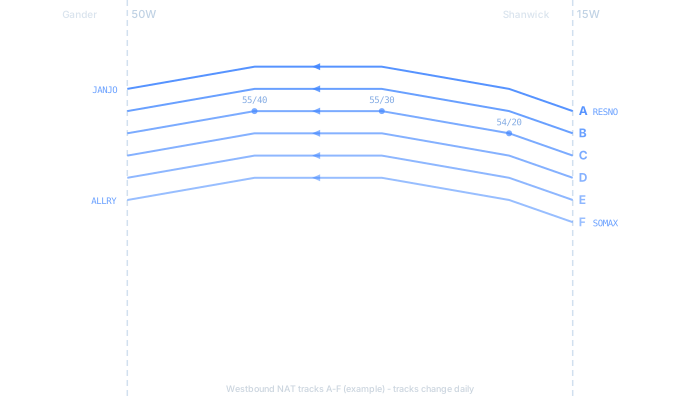
Tracks curve northward mid-ocean because the jet stream - a river of fast-moving air at cruise altitude - typically flows west to east across the North Atlantic. Westbound flights route to minimize headwind; eastbound flights route to maximize tailwind.
Track structure
A typical NAT track looks like this:
NAT Track Alpha: PIKIL 54/20 54/30 54/40 53/50 HOIST
That's a series of waypoints defined by latitude/longitude. The aircraft enters at a named fix (PIKIL), crosses the ocean at specific coordinates (54N 20W, 54N 30W, etc.), and exits at another named fix (HOIST) to rejoin the airway structure.
Each track has assigned flight levels. Track A might be available at FL350, FL370, FL390. Track B at FL340, FL360, FL380. This provides vertical separation between adjacent tracks.
Oceanic separation
Over the ocean, without radar, controllers use:
- Lateral separation - 60nm between tracks (reduced to 23nm with ADS-B or ADS-C)
- Longitudinal separation - 10 minutes between aircraft on the same track and flight level (reduced to 5 minutes with performance-based navigation)
- Vertical separation - 1,000ft (RVSM applies over the ocean too)
Aircraft report their position at each waypoint via HF radio or satellite datalink. The controller updates their estimated position and checks separation. It's much slower and less precise than radar-based control.
Random routing
Not all oceanic traffic uses the organized tracks. Aircraft can file "random routes" outside the track structure. This is common for flights that don't fit the track timing, flights going to destinations not served by the tracks, or aircraft that want to optimize for their specific performance.
Random routes still need oceanic clearance and still follow separation standards.
The transition
Getting onto a NAT track involves coordination between domestic ATC and oceanic ATC. Aircraft receive their oceanic clearance before reaching the ocean boundary. The clearance specifies which track, which flight level, and the Mach number to maintain (speed control is critical for longitudinal separation over the ocean).
The busiest entry points are on the European side - Shannon, Prestwick, and Santa Maria handle westbound departures. On the North American side, Gander and New York oceanic handle eastbound entries.
In radarcontrol.io
NAT tracks and oceanic control are not currently simulated. The sim focuses on domestic radar-based ATC where controllers have continuous radar coverage. Oceanic control is a fundamentally different discipline - position-based rather than radar-based, with much larger separations and slower update rates.
Some radarcontrol.io airspaces include oceanic entry/exit points. Scottish Center and the Reykjavik Center border the NAT tracks, and you'll see aircraft entering and exiting at oceanic waypoints.
Guides: What is an ARTCC? | What are airways?
Related: What is RVSM? | What is Mach number? | What is a flight plan?